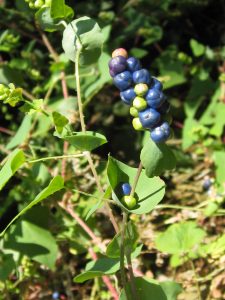
Quick link to RIISC list of invasive and weedy plants of Rhode Island
IMPORTANT NOTE: The Rhode Island Natural History Survey promotes awareness of and actions to manage invasive species as part of its mission to promote ecosystem resilience, conserve biodiversity, and engage curious observers in field-based experiences. Neither the Rhode Island Natural History Survey nor the Rhode Island Invasive Species Council have any authority with respect to invasive species policy or regulation in Rhode Island.
In its 2026 session, the General Assembly passed the state’s first comprehensive invasive plant statute to the effect that: no person shall import, disperse, distribute, introduce, or sell, in the state any species of non-native (exotic) invasive plants, as defined by the director. The director shall promulgate rules and regulations governing the prohibition and its applicability. This prohibition and enforcement will not take effect until regulations have been promulgated by RIDEM, and this is likely to take some time. We will update this page when that happens.
In the meantime, for the Survey’s non-regulatory purposes as stated above, we use this definition . . .
an invasive species is any species of animal or plant that is:
—introduced to a country or region (in our case Rhode Island) where it is not native (it is “alien” or “exotic”);
—reproducing and spreading without the aid of cultivation (it has become “naturalized”)
—producing net harm to one or more native resources such as species, habitats and natural communities, or ecosystems.
Invasive species cross-cut many parts of the Survey’s mission, from conservation land stewardship to wetlands monitoring and from biodiversity management to native plant promotion. Invasive species may also impair non-biotic conservation values that are intrinsic to a particular parcel of land, such as aesthetics, cultural landscapes, or recreational use.
Besides for regulation, lists of invasive species are made for various reasons and exhibit various subtleties. Many different lists of Rhode Island invasive species have been made over the years, therefore, and some of these can be found in the Resource Library, search for the keyword “invasive”.
RI Invasive Species Council
The Natural History Survey chairs the Rhode Island Invasive Species Council, a voluntary collaboration among organizations with substantial interests in the prevention, documentation, and management of invasive species in the state, originally created in response to the 1999 U.S. federal Executive Order on invasive species. RIISC’s mission is to gather and convey information on the presence, distribution, ecological and economic impacts, and management of invasive species; promote uses of native species and non-invasive alternatives throughout Rhode Island; and work cooperatively with researchers, conservation organizations, government agencies, the green industries, and the general public to identify and manage invasive species pro-actively and effectively.
Goals of Rhode Island Invasive Species Council include:
- to protect native biodiversity;
- to conduct scientifically based assessment;
- to promote the use of native and non-invasive non-native alternatives;
- to manage and control invasives in minimally-managed habitats;
- to encourage research on control methods;
- to develop assessment methods for potential invasiveness;
- to educate the general public;
- to work cooperatively among all involved parties.
The RIISC is a voluntary collaboration of interested parties. It is not a program or office of the state of Rhode Island and has no regulatory authority.
The Rhode Island Invasive Species Council is an outreach program of the Rhode Island Natural History Survey, The Rhode Island Agricultural Experiment Station, and The University of Rhode Island Cooperative Extension.